Skip navigation |

A Valued Profession

Industry report highlights a valued profession

Most senior managers say grounds managers are an essential part of the organisation in which they work, according to the latest IOG-funded industry research. However, the project has also revealed that, in a minority of cases, some groundscare staff are sometimes described as ‘glorified farmers’ and ‘grass cutters’

Carried out by the Sport Industry Research Centre at Sheffield Hallam University and financed via the IOG’s 2012 Fund, the research examined the relative status of grounds staff and the key issues identified by senior managers. A survey of senior managers compared occupational groupings including grounds staff, coaching/instructors, catering, retail and merchandising, cleaning, sales and marketing, administration, parks and gardens, and security staff. The survey compared these groups using criteria that included average pay, skills, qualifications, training and labour turnover – and the headline findings are encouraging for the groundscare profession.

According to respondents, two groups (parks and gardens, administration) were perceived to be of equal importance to grounds staff; two were felt to be of greater importance (sales and marketing, coaching/instructors) and four were perceived as less important (catering, cleaning, security, retail and merchandise).

The report also included analysis of 20 interviews (with six head groundsmen/grounds managers, 13 senior managers and one voluntary committee member) to analyse issues in detail. Perceptions of grounds staff were often mixed, with some senior managers communicating positive attitudes towards grounds staff and obviously engaging in a strong working relationship with them. A minority of interviewees, however, testified to less fortunate perceptions among some of their peers, with grounds staff sometimes described as ‘glorified farmers’ and ‘grass cutters’. This represents a major concern for the profession, even though it is a minority view.

When poor working relationships occurred between grounds staff and senior management, they were typically caused by broken chains of communication. Recommendations in the report state that the IOG should address this through a sustained approach to engaging senior managers, sports agencies and professional ‘champions’ within the industry, to promote the profession and the skilled nature of its workforce. Advocacy of the professional merits of grounds staff might also encourage more senior managers to give grounds managers greater decision making powers to achieve success.

Many in the profession often worry about the image grounds staff portray to other staff and the general public, which some believe has contributed to the lack of young people entering the profession. The research showed that progress has been made from the ‘cloth cap’ image, despite the outdated views of the minority. Positive changes were mainly apparent for grounds staff who maintained natural sports surfaces of high quality - this commanded the respect of senior management, players, coaches and spectators alike.

groundsman at workRecommendations in the report suggest that the IOG support ways to improve the image of grounds staff through effective PR and positive media relations. They also support the development of centres of excellence to help promote the virtues of grounds management.Raising the profile of the industry will help to attract the next generation of young grounds staff.

The report discusses the effect of recession on the industry. Cutbacks will occur according to some interviewees, leading to job losses or reduced funding which will hit the standard of surfaces, potentially affecting the gains made in terms of the image of grounds staff. Organisations’ cost cutting measures may also lead to a greater reliance upon contractors. Many interviewees suggested this will affect the standard of pitches negatively, because of the time pressures put on contractors and the fact that they often lack a sense of ‘ownership’ due to the amount of grounds they often maintain.

Synthetic surfaces are a contentious issue within the industry and interviewees mentioned that they felt these surfaces lessened the role and involvement of grounds staff. Many, however, understand the continued development and usage of synthetic surfaces within communities and organisations. The consensus is that synthetic turf is a complementary surface not a replacement for natural turf.

Recommendations in the report state that the IOG should lead on initiatives to ensure that grounds staff are responsible for the maintenance of synthetic pitches, at all levels, and therefore receive the relevant training to do this effectively. This would also help to dismiss the myth that synthetic surfaces do not need maintaining.

The report supports the IOG’s six-year Challenging Perceptions strategy launched in 2006.It highlights low pay, the structure of training for grounds staff and the ageing grounds maintenance workforce as areas of concern for the profession. Low pay is a concern for many interviewees and survey respondents, although many felt this would be difficult for the profession to overcome in the current economic climate.

The IOG should therefore seek to be proactive in its efforts to promote uniformity of pay in the profession, including leading on pay scales and regional weightings. Regarding the ageing workforce, the IOG needs to support managers with succession planning, by raising awareness and providing workable solutions to help ease the problem. Some examples of good practice already exist with evidence of organisations planning effectively over the last 10-15 years to avoid problems associated with an ageing workforce. Others suggested that the older workers should be encouraged to stay in the industry to help train the next generation of specialists.

One of the major concerns expressed by senior managers in the report was the effectiveness of NVQ training. Many felt that young people are inadequately trained because of their involvement in the NVQ scheme, compared with older grounds staff who had trained on City & Guilds courses. Many felt that entry workers need a lot of in-house training to get them to the required standard and that they lack in-depth knowledge in a range of areas related to their work.

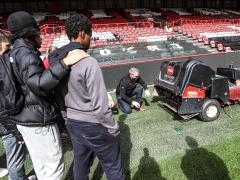
Therefore the report’s recommendations suggest that the IOG needs to lead on education and training structures, to enhance entry level qualifications. This should involve a careful review of progression in relation to the importance, recognition and availability of relevant courses. A closer partnership with education providers needs to be encouraged. This could help to support training camps for young people in prestige venues, where they can become inspired to work in the profession.

There are still many challenges facing the profession and much progress still to be made, although many of the issues do not appear to be as bad as many in the profession think.

The response rate in the research was relatively low, with less than 23 per cent of the head grounds staff approached providing senior management contact details, and only 124 senior managers responding to the survey. This small response demonstrates that much has still to be done to further engage and energise the groundscare industry, and the IOG needs to take a firm lead on the key issues identified if the profession is to make greater gains.